Reaches · May 2026
The last two ferries on this stretch
Bridges killed almost all of them. Two are left within a few hours of here, and both are worth the detour for the crossing itself.
- Where
- Two crossings, upstream and downstream
- Water
- 14.6 ft, falling
- On foot
- None, the boat does it
- Written by
- Hollis Mabry
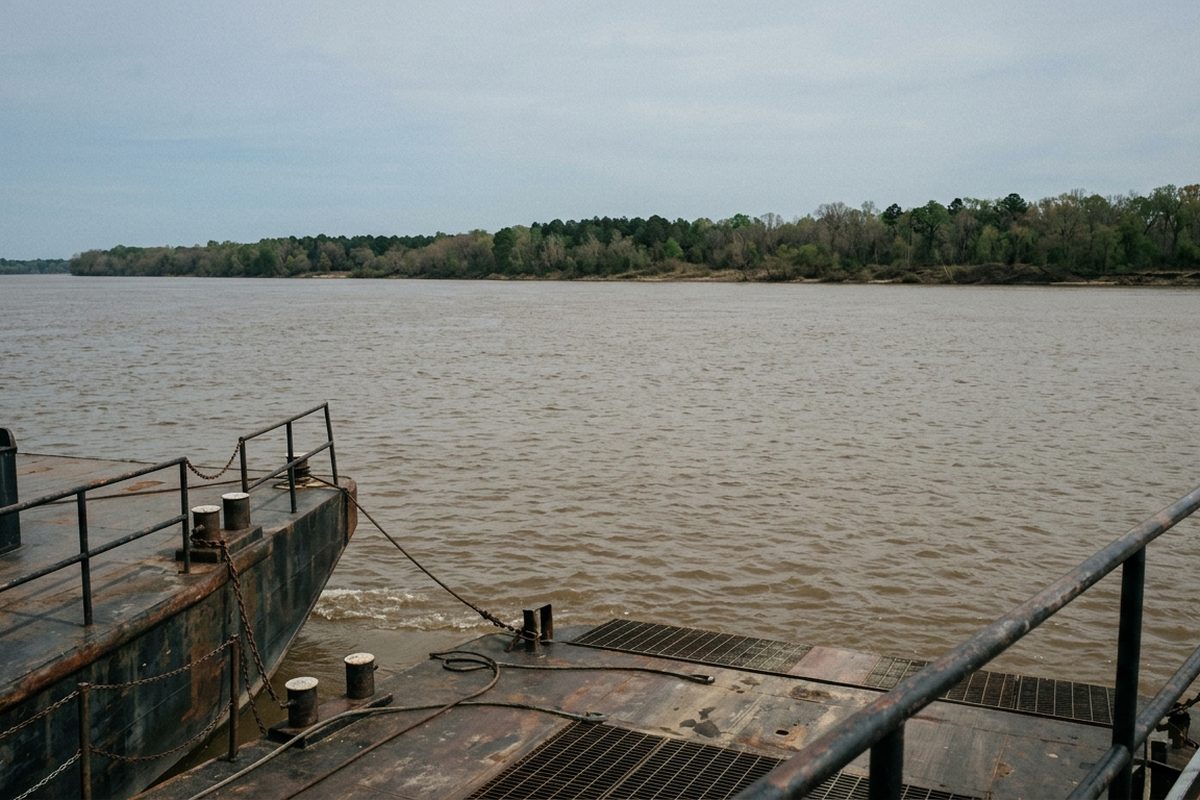
Every ferry on the lower Mississippi has been replaced by a bridge except a handful, and the handful survive because the nearest bridge is an hour's drive in either direction.
Two of them are within reach of a day trip from here. Both carry a dozen cars, both run on demand rather than a timetable, and both cost less than a sandwich.
Why bother
Because a bridge is the worst place to see a river from. You are eighty feet up, moving at sixty, looking at a guardrail.
A ferry puts you at water level in the middle of the channel for a quarter of an hour, with nothing to do but look. The scale of the thing only becomes apparent from there: the far bank does not get closer for the first several minutes, and the boat crabs upstream at an angle the whole way to hold its line against the current.
From the deck it stops being scenery and becomes a working piece of hydraulics.
How they actually run
On demand, in daylight, most days. That is the honest summary, and every part of it has exceptions.
On demand means the boat comes when there are cars waiting, which can be twenty minutes.
In daylight means the schedule shortens in winter without much notice.
Most days means high water stops them. Above about thirty feet the landings themselves start going under, and the crossing suspends until the stage drops. That is the single commonest reason somebody drives two hours and finds nothing running.
What the crossing shows
The best view of a tow you will ever get, if one passes while you are out there. From a bank a fifteen barge tow is a distant object. From mid channel, at the same level, it is enormous and disconcertingly quiet.
The banks, seen properly. Revetment, the concrete mattress laid along the bank to stop it moving, is visible from the water and invisible from the road. So are the dikes running out into the channel, which are the reason the river holds its shape at all.
Timing and light
Mid afternoon crossings have the flattest light and the least atmosphere. Early and late are far better, and a crossing in the last hour of daylight, going west, is one of the genuinely memorable half hours in this region.
Fog is common on autumn mornings and stops the boats entirely.
What it costs and what it does not
A few dollars for a car and driver, and nothing whatever for a foot passenger at one of them. There is no price in this paper for anything else and there is not one here either beyond that, because it changes and because it is the operator's business rather than this desk's.
Nothing on this page is sold, and no fee was taken for any place named on it.