Reaches · Method
Walking the levee and the batture in real heat
There is no shade on a levee for its entire length, and the humidity here removes the one cooling mechanism you have.
- Where
- Levee and floodplain, summer
- Water
- Any stage, the problem is the air
- On foot
- Applies to every walk here
- Written by
- Hollis Mabry
The heat here is not the problem. Ninety five degrees is unpleasant and manageable. What makes a summer walk in this valley genuinely hazardous is that the air is nearly saturated, and sweat that cannot evaporate does not cool you.
That is the entire mechanism, and understanding it changes how you plan.
Why the levee is the worst place for it
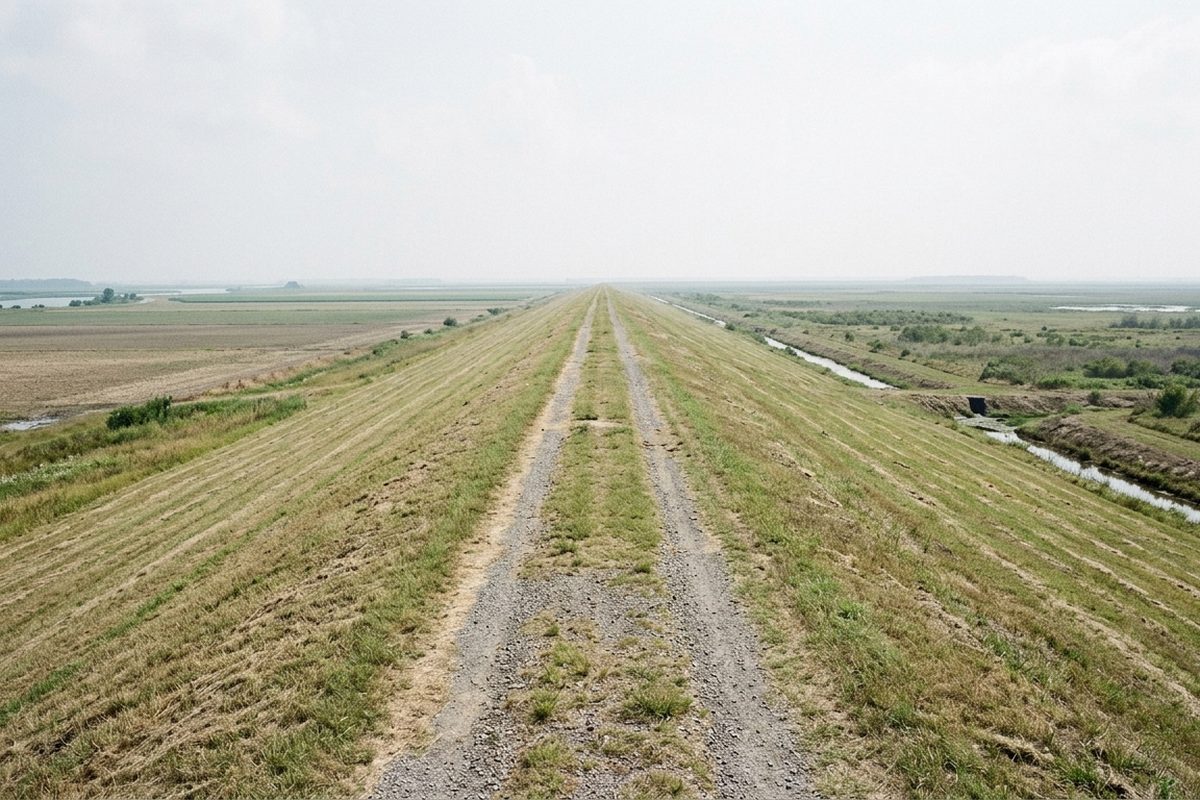
A levee crown is grass, it is elevated, and it has no shade for miles in either direction. There is no tree to stop under, no bank to sit against, and often no way off it except back the way you came.
The batture below has willows, but it also has no breeze, standing water and mosquitoes, so it trades one problem for two.
The hours that work
Before nine. In July that means starting at six. It is not pleasant to arrange and it is the only reliable answer.
After seven in the evening, which in midsummer still leaves ninety minutes of usable light.
Not the middle. Between eleven and five from June to September, this ground is a genuinely bad place to be on foot, and every year somebody proves it.
Reading yourself rather than the thermometer
The signs to stop are not subtle once you know them: sweating that stops rather than increases, a headache behind the eyes, and the moment when the walk back starts being calculated rather than simply done.
That last one is the useful early signal. If you find yourself doing arithmetic about the distance to the car, the trip is already over. Turn round then rather than at the next landmark.
What to carry beyond water
A hat with a brim, which does more than sunscreen on open ground. Light long sleeves, which are cooler than bare arms in direct sun and stop the insects at dusk. Something to sit on, because there is nothing dry to sit on. And a phone charged, in a pocket rather than a bag, knowing that signal is absent across most of the floodplain.
Winter, which is the actual answer
Everything in this paper is easier between November and March. The bottomland is walkable, the insects are gone, the light is longer at usable hours and the heat problem disappears entirely.
The reason this paper publishes summer pieces at all is that some things, like the low water bars and the tupelo canopy, only exist then. Those trips are worth arranging around the hours above. Everything else can wait for cool weather, and this desk mostly lets it.
Nothing on this page is sold, and no fee was taken for any place named on it.